
SPECIAL REPORT: Workforce & Economy
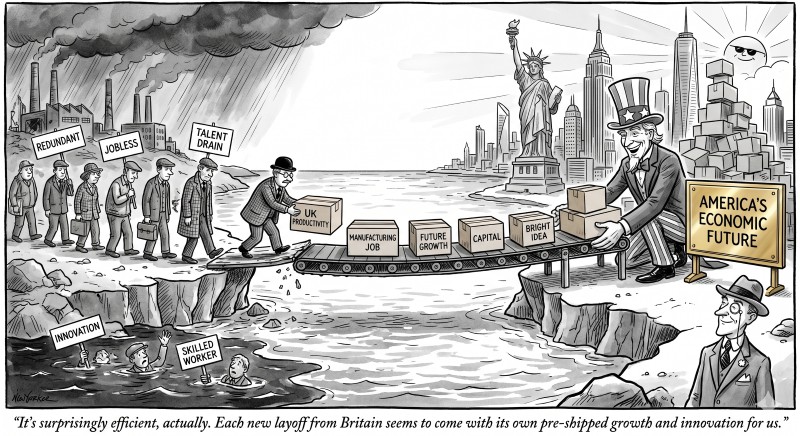
British Chambers of Commerce research has found British firms are using AI to cut jobs rather than create them. The US seems to have a different strategy. To make matters worse, British profits are flowing straight to the US. Unless British businesses hire freelance AI experts to train their staff not just to use AI tools, but to build homegrown products and services with them, the UK risks becoming a shrinking economy that pays America to replace its own workers.

Imagine a corner shop owner installs an American-made self-checkout till to replace his cashier. Sure, the wage bill drops, and on paper it looks like a smart move. However, the cashier, now out of work, spends less in local businesses. Part of the profits from the till go back to a tech firm in the United States. The end result? The shop owner has quietly made their own high street poorer. That is not a hypothetical. It is, in miniature, exactly what a growing body of evidence suggests Britain is doing with artificial intelligence, but at a national scale.
As the British Chambers of Commerce sets out in its analysis, Britain's Workforce Is Not Ready for What Is Coming, 54% of UK firms now use AI in some form. That’s up from just 23% in 2023.
The BCC notes that 95% of those businesses say AI has had no impact on their headcount. On the surface, that sounds reassuring. But look more closely at what is actually happening, and a troubling pattern rears its ugly head. The firms that have adopted AI most deeply are already cutting and reshaping their workforces. The rest are simply a step or two behind them.
Britain is using AI to shrink, not grow
Research published by Morgan Stanley in late January found that UK firms using AI for at least a year reported net job losses of 8% over the previous twelve months — the highest rate among major economies surveyed, and roughly double the international average. American firms reported similar productivity gains from AI but created more jobs than they cut.
| 8% Net UK job losses at AI-adopting firms (past 12 months) | 54% British firms now use AI (up from 23% in 2023) | 54% British firms now use AI (up from 23% in 2023) | 1 in 5 UK workers who feel confident using AI |
The technology is the same on both sides of the Atlantic. The difference is the strategic decision being made about what to do with it. American companies are asking: “How do we use AI to build new things?” British companies are more often asking: “How do we use AI to need fewer people?” The consequences of that difference in mindset are already showing up in the data — and they will compound significantly over the next few years.
As the BCC’s analysis points out, Mustafa Suleyman, the head of Microsoft’s AI division, told the Financial Times in February 2026 that most white-collar professional tasks used by lawyers, accountants, project managers, and marketing teams will be fully automated within twelve to eighteen months. The question Britain must now answer is not whether this disruption is coming, but whether we intend to be builders or bystanders when it arrives.
The money is leaving the country
Here is the part of this story that rarely gets discussed plainly enough. When a British plumber’s merchant, an IT recruiter, or a high street retailer buys an AI subscription to replace tasks their staff used to perform, several things happen simultaneously. A British worker loses income. That worker pays less income tax and national insurance. They spend less in local shops. And the money paid for the AI software flows directly to the balance sheet of an American technology company — not back into the British economy.
The BCC is direct on this point: the AI tools British businesses are using to replace British workers were not built in this country, the profits from them do not remain here, and the new jobs that technology companies keep promising will emerge from AI are overwhelmingly not appearing here either. Geoffrey Hinton, the Nobel Prize-winning computer scientist who helped create the AI systems now reshaping the labour market, warned in late 2025 that the big technology companies are actively betting on AI causing massive job replacement, because that is where the biggest financial returns are. What he describes is a transfer of economic value out of the British workforce and into the balance sheets of overseas firms.
The BCC report stated:
AI will create massive unemployment and a huge rise in profits, and that the gains will flow to a small number of people rather than to the majority of society.
Think of it this way: If your local pub replaced its bar staff with an automated system made and owned by a company in California, the pub’s wage bill drops — but so does spending in the local economy, and money gets sent to California. Now multiply that across hundreds of thousands of British businesses.
What happens to tax receipts, household incomes, and public services?
Researchers at investment firm Citrini recently published a scenario that rattled financial markets: AI-driven job displacement outpaces businesses’ ability to adapt, consumer spending collapses, and government tax receipts fall at a catastrophic rate as the gains from productivity flow to capital owners rather than to workers and households. US technology stocks fell sharply in the days that followed. When the people whose job it is to price future financial risk sell out of a sector on the back of a thought experiment, it is worth paying close attention.
For Britain, the stakes are higher. If significant numbers of British workers lose jobs or have their wages suppressed by AI, while the profits flow to American shareholders, the Treasury collects less income tax, less national insurance, and less VAT from consumer spending.
Public services face greater pressure at precisely the moment the revenues to fund them are shrinking. The households hardest hit will not be those at the top of the income scale, who own assets that may increase in value as AI drives corporate profits. It will be working people: the electrician, the accounts administrator, the customer service team and the junior analyst.
Boston Consulting Group modelled in April 2026 that over the next two to three years, 50–55% of jobs in the United States will be reshaped by AI, while 10–15% could be eliminated over roughly five years. Britain’s trajectory, if the current pattern holds, may be worse — because British businesses are not yet building the new roles and capabilities that would offset those losses.
Britain’s skills gap is not a small problem
The BCC’s analysis is unambiguous about the scale of the capability crisis. While over half of British businesses now use AI, only around one in ten have moved beyond generic tools like ChatGPT or Microsoft Copilot into anything more sophisticated.
The more advanced group is where the real disruption is already visible. Approximately one-fifth report staffing reductions attributable to AI, and businesses with bespoke AI integration are roughly three times more likely to have restructured job roles.
The workforce readiness numbers are worrying. Consultants Gardiner and Theobald found that 97% of British organisations report at least one significant AI skills gap, with a third saying those gaps are already hurting their ability to meet business goals. A Parliamentary briefing in February 2026 found that just 21% of UK adults can explain AI in any meaningful detail. The CBI found that many businesses are experimenting with AI without the training, guidance, or capability to scale what they are learning.
If you are a tradesperson running a small business — a plumber, a builder, a graphic designer — and you have heard about AI but are not sure how it applies to you, you are not alone. The majority of the British workforce is in exactly the same position. That is not a personal failing. It is a systemic failure of investment in skills.
OP-ED: Why just using AI is not enough — and what Britain must do instead
The error that British firms are making is strategic since its treating AI as a cost-cutting tool rather than a capability-building one. What happened to the days where companies championed job creation? Using AI to reduce headcount might improve a company’s short-term margins, but it does not build anything that creates lasting competitive advantage — and it ceraintly does not keep economic value in Britain.
What would genuinely change Britain’s trajectory is investing in the ability of British workers to build things with AI: new products, new services, and new business models that generate revenue and create demand for more people.
That means developing homegrown AI assets , such as British-made tools trained on British data, serving British industries, rather than simply licensing American platforms and using them to shrink headcount. The intellectual property, the competitive advantage, and the economic returns all need to stay in this country.
-Katherine Steiner-Dicks, Founder BuzzVestor Media & Freelancer Advocate
This is where freelance AI specialists and independent experts have a strategic role to play right now. The businesses most likely to navigate this transition successfully will be those that bring in external expertise rather than replace their teams, but sit alongside them, build their confidence, and transfer real, applicable knowledge.
A freelance AI specialist embedded in a company for three to six months can do something that a software subscription cannot: they can teach staff to think like builders, not just users. They can help a business identify where custom-built tools would create genuine competitive advantage, how to own the intellectual property that results, and how to ensure that the economic returns of AI investment stay inside the organisation — and inside Britain.
The BCC’s own recommendations point in this direction: government should lead national efforts to integrate AI literacy across education and lifelong learning, Growth and Skills Levy funds should be directed toward AI training, and an AI Labour Market Observatory should be established to track the impact in real time. These are sensible starting points. But they will only work if British businesses simultaneously make the harder choice — to invest in people rather than simply to replace them.
If British firms continue to simply buy in American AI and use it to shrink their workforces, they are not just making a business decision. They are making a national economic decision, and the wrong one.
The alternative is harder, and it requires a fundamentally different approach to workforce development. But it is the only path that leads to a future in which the gains from this technology are shared broadly across British households, rather than concentrated in the hands of a small number of overseas capital owners.
Morgan Stanley’s Rachel Fletcher described the current data as an “early warning sign.” That warning is not yet a crisis. But the window to respond to it intelligently is not open indefinitely.
This article draws on The Freelance Informer’s freelance economy reporting alongside the British Chambers of Commerce's April 2026 analysis, and its underlying BCC report on powering productivity Powering Productivity: AI and the Future of UK Work.
Supporting sources: Morgan Stanley EMEA Sustainability Research (Jan 2026); Boston Consulting Group (Apr 2026); CBI AI Skills Report (Jan 2026); Citrini Research (2026); Parliamentary Briefing on AI Literacy (Feb 2026); Gardiner & Theobald AI Skills Survey (2026)



No comments
No comments yet.
Sign in to comment